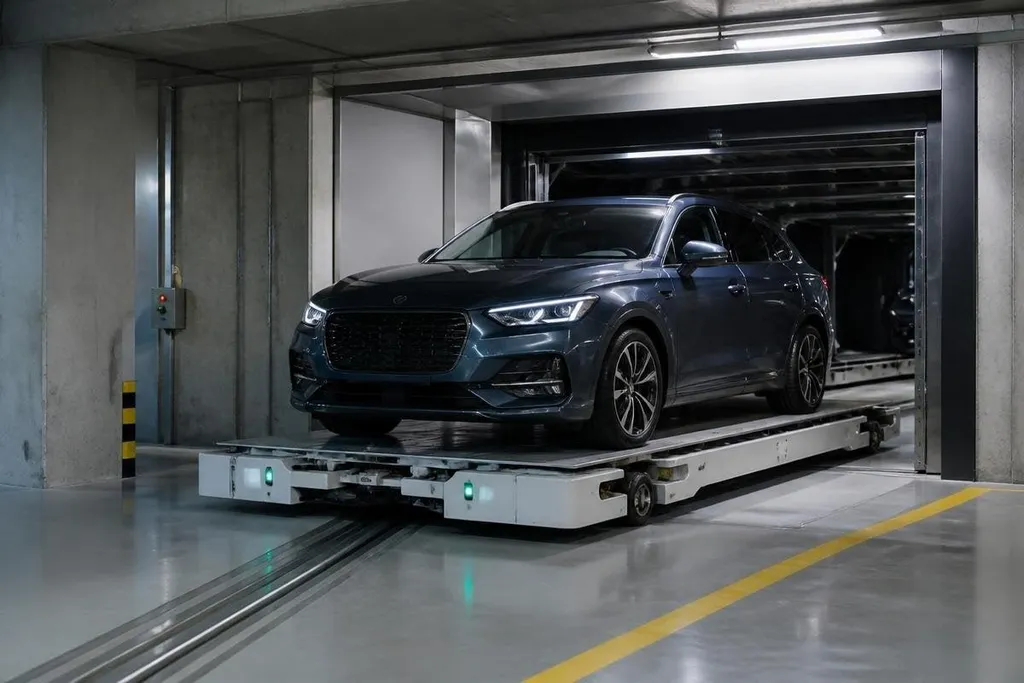
A parking robot may move a car without a driver, but its hardest job starts after the vehicle enters the garage. It must find space, avoid people and walls, place the car accurately, and return it without turning a short visit into a long wait.
- The robot needs accurate maps and vehicle measurements.
- Storage density matters as much as driving ability.
- Charging, recovery, and human access can decide the business case.
What a parking robot has to do
Most automated parking systems combine cameras, LiDAR, floor markers, control software, and moving equipment such as lifts or transport platforms. The system records where the car is, checks the available space, and plans a route through a building with little room for error.
That route may include tight turns, ramps, narrow lanes, and several changes in height. A small position error can leave a vehicle too close to a wall, block another car, or force an operator to enter the garage and fix the problem by hand.
The robot also needs to identify the car before it moves. Vehicle length, width, height, weight, and wheel position affect where the system can store it. A layout built around small cars may need a different design from one that accepts large sport utility vehicles.
Storage density is the real prize
Parking robots attract attention because they can change how a garage uses its floor area. If people do not need to open doors or walk between parked cars, spaces can sit closer together. A lift or transfer platform can then move vehicles into storage rows that would be hard for a human driver to use.
That extra capacity has a direct value for a garage owner. More cars can fit inside the same building, while the design can reserve less space for driving lanes. The gain depends on the equipment, the building shape, local safety rules, and the time needed to retrieve each vehicle.
Retrieval time needs a careful test. A system that stores cars tightly may need to move other vehicles before reaching the one a customer requested. The parking process then saves floor area but adds waiting time at the exit.
The hard cases happen around people
A garage is a poor place for a robot to guess. People walk between vehicles, doors open without warning, luggage falls onto the floor, and a driver may stop in an area meant for robot traffic. Sensors must detect these changes and bring the system to a safe state.
Human access creates another problem. Staff need a clear way to enter a storage area, remove a damaged vehicle, and restart the system after an emergency stop. A recovery plan matters as much as normal movement because one disabled car can affect every vehicle behind it.
The design also has to handle cars that arrive in poor condition. Mud can hide markings, a roof box can change the vehicle height, and a flat tire can alter the car’s position on a platform.
These cases need rules that operators can follow without guessing.
Parking rules also need to cover what happens when a robot runs low on power or loses its route. A report at Robot24.com can place the parking task, site, test date, and battery result beside the machine before the next section looks at how charging changes the job.
Charging changes the parking job
Electric vehicles add another task. A parking system may need to place a car beside a charger, connect a charging plug, and release the vehicle when charging ends. The connector must reach the car without being trapped by another vehicle or moving platform.
Charging also changes the timing. A customer may want a car ready at a set hour, while the garage operator may need to move several vehicles before that car reaches an exit lane. Software must match the customer’s request with the physical order of the stored vehicles.
This is where many broad claims about parking robots become hard to judge. A system can move cars well in a controlled demonstration and still face long waits, blocked access, or costly manual recovery during daily use.
A practical test before buying
Owners comparing systems should ask for answers in writing:
- Map the building: confirm the slopes, ceiling heights, turning areas, and floor load limits the equipment can handle.
- Time retrievals: measure the wait for the first car and for several cars requested close together.
- Test awkward vehicles: include a large vehicle, a car with a roof box, and one with a flat tire if the system claims to accept them.
- Check recovery: ask who can enter the storage area, how a trapped car is removed, and how the system restarts.
- Price the service: include construction work, software, maintenance, power, staff training, and charger repairs.
I’d judge a parking robot by its worst normal day, not its cleanest demonstration. The winning design will be the one that keeps a full garage moving when a person parks badly, a sensor needs cleaning, or the requested car sits behind five others.